Mindset Growth Hub — Practical courses taught by people who do the work
Home  ‹  Programs & Courses  ‹  AI for Finance Advanced
Finance is no longer just reports about the past

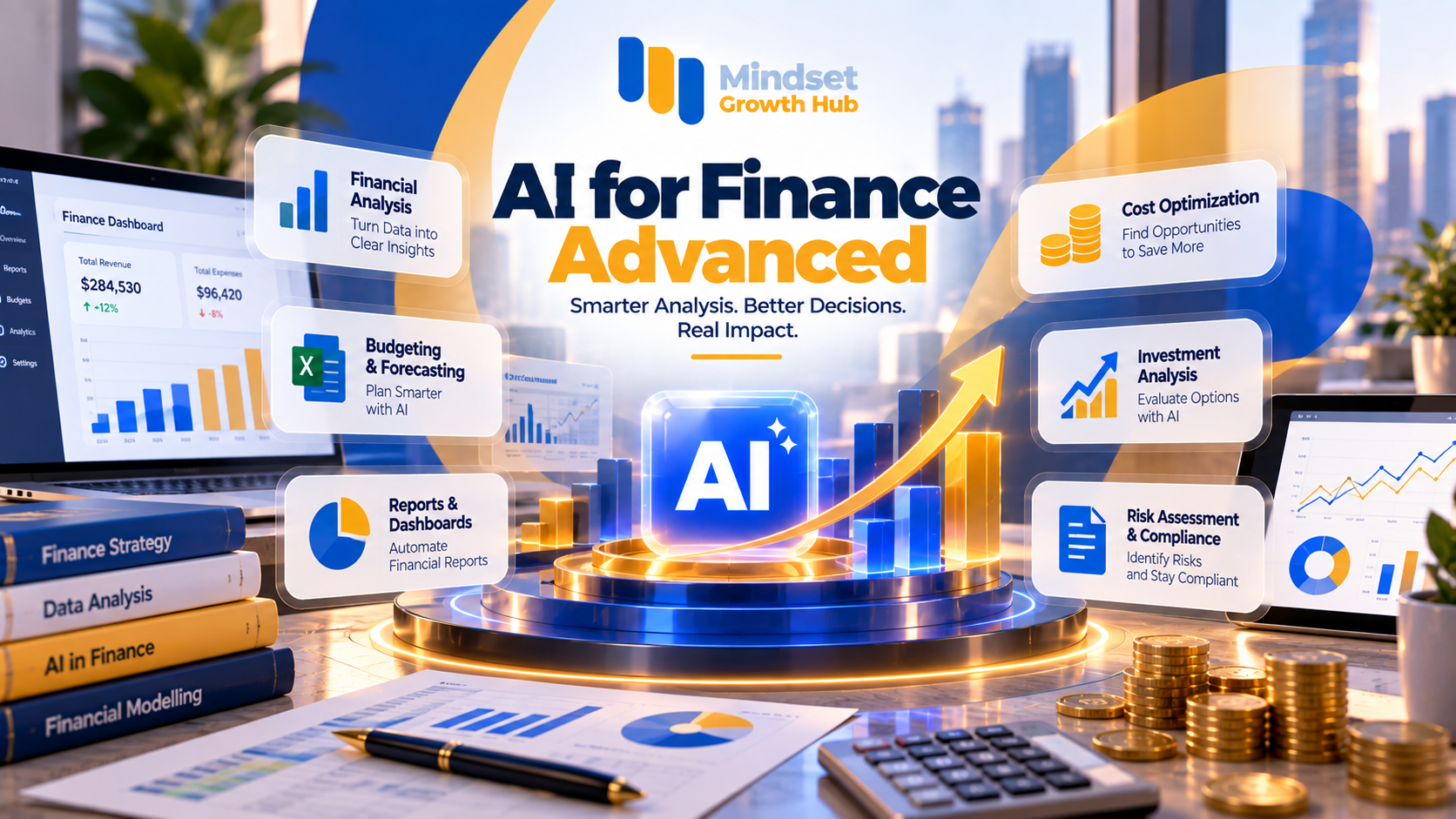
AI for Finance Advanced

Advanced AI for finance and financial analysis — from numbers and reports to forecasting and decision-making
6 Accredited Hours 3 Days Advanced
Officially accreditedProfessional attendance certificate accredited by NAHJ
Program overview

About the program

An Advanced workshop for those who want to move from the traditional use of finance tools to building a smart finance system powered by data and AI — from analyzing financial statements, to forecasting and scenario building, all the way to an AI agent that monitors financial performance automatically. Training is done on real financial files, not theoretical examples, and every session ends with ready-to-use templates for budgets, forecasts and KPI dashboards. The final project is an integrated smart finance system that supports management decisions.

  • On your data — training uses real financial files, not theoretical examples
  • Ready-made models — budget, forecast and dashboard templates from every session
  • An integrated system — the final project is a smart finance system that supports management decisions
  • 16 practical outcomes across 8 finance areas

Core Program Objective

  • 01Use AI to analyze financial statements and ratios and produce executive management reports
  • 02Build data-driven budgets and rolling financial forecasting models
  • 03Plan scenarios, manage cash flow and support financial decisions
Program goals

What will you be able to do after the program?

Analyze financial data using AI
Analyze financial statements faster
Build and analyze financial ratios
Create professional financial reports
Run Budget vs Actual analysis
Detect variances and their root causes
Build budgets with AI
Create financial forecasts
Build Best / Base / Worst case scenarios
Analyze and manage cash flow
Calculate cash runway
Build an executive financial dashboard
Detect risks and anomalies with AI
Automate financial reporting
Design financial AI agents
Build an AI finance system that supports management’s financial decisions
The development journey

Before and after the course

Before the Program

  • Reports that describe what happened in the past
  • Slow manual analysis of statements and ratios
  • A single-number budget and cash managed by surprise
  • Spotting variances after they become problems
  • Monthly reports prepared by hand
Learning Journey

After the Program

  • Financial forecasts that support decisions ahead of time
  • Faster AI analysis with insights and recommendations for management
  • Best / Base / Worst scenarios and continuous cash forecasting
  • Early-warning indicators and automatic financial alerts
  • Automated reports and a smart finance agent monitoring performance
Target audience

Who is this program for?

CFOs & Finance Directors

Leaders of finance departments.

Why it fits you

You build a smart finance system that supports top-management decisions with forecasts, not just reports.

Accountants & Chief Accountants

Those responsible for financial statements and periodic reports.

Why it fits you

Cut analysis and reporting time and automate repetitive tasks.

Financial Analysts & FP&A Teams

Financial analysis and planning teams.

Why it fits you

Build rolling forecasts, scenarios and executive dashboards.

Budgeting & Planning Teams

Those who prepare and track budgets.

Why it fits you

Prepare budgets with documented assumptions and analyze Budget vs Actual with AI.

Internal Auditors

Internal audit and control teams.

Why it fits you

Detect anomalies and financial risks early.

Business Owners & CEOs

Decision-makers in the organization.

Why it fits you

See your organization’s financial position in one dashboard and make data-driven decisions.

Financial Consultants

Those advising clients on finance.

Why it fits you

Deliver faster, sharper analysis and recommendations to your clients.

Learning path

The course journey

01
DAY 1

Session 1: Financial Analysis & Smart Reporting

2 hours

AI in modern finance • Financial statements & ratios

Details
02
DAY 2

Session 2: Budgeting, Forecasting & Decisions

2 hours

AI-powered budgeting • Financial forecasting

Details
03
DAY 3

Session 3: Dashboards, Risk & Automation

2 hours

Executive finance dashboards • Key financial KPIs

Details
Details

Training content in detail

01

AI in Modern Finance

7 topics

Session 1 — how AI changes everyday finance work, and how to write professional prompts and analyze your financial files with it.

Topics covered

  • The role of AI in modern financial management
  • Key AI applications in finance
  • AI tools for finance tasks with ChatGPT and Claude
  • Prompt engineering for accountants and finance professionals
  • Designing professional financial prompts
  • Analyzing Excel and CSV files with AI
  • Detecting errors and abnormal values

Practical skills

Prompt engineeringAI analysis of financial files
Expected deliverable:

Session 1 — reading and analyzing the three financial statements and calculating financial ratios with AI.

Topics covered

  • Reading and analyzing financial statements
  • Income statement analysis
  • Balance sheet analysis
  • Cash flow statement analysis
  • Calculating and analyzing financial ratios
  • Profitability analysis
  • Liquidity analysis
  • Solvency analysis
  • Efficiency ratios

Practical skills

Financial analysisRatio analysis
Expected deliverable:

Session 1 — comparing performance, detecting variances and turning complex data into executive reports.

Topics covered

  • Comparing financial performance across periods
  • Actual vs Budget analysis
  • Variance analysis
  • Revenue and expense analysis
  • Profit margin analysis
  • Spotting trends and patterns
  • Creating an executive financial summary
  • Turning complex data into management reports

Practical skills

Variance analysisExecutive reporting
Expected deliverable: Build an AI Financial Analyst: data intake → performance analysis → KPI calculation → variance detection → insights → recommendations for management.

Session 2 — data-based assumptions, and budgets compared with actuals alongside suggested corrective actions.

Topics covered

  • Building a budget with AI
  • Department budgeting
  • Revenue budget
  • Expense budget
  • Operating budget
  • Cash budget
  • Building budget assumptions
  • Budget vs Actual comparison
  • Analyzing the causes of variances
  • AI-suggested corrective actions

Practical skills

BudgetingBudget vs Actual analysis
Expected deliverable:

Session 2 — forecasts that update automatically with every new actual result.

Topics covered

  • Using AI in financial forecasting
  • Revenue forecasting
  • Expense forecasting
  • Profit forecasting
  • Cash flow forecasting
  • Monthly and quarterly forecasts
  • Rolling forecasts
  • Forecast accuracy analysis
  • Updating forecasts with actual results

Practical skills

Financial forecastingRolling forecasts
Expected deliverable: A complete operating budget for your organization with documented assumptions, and a rolling forecast model that updates with every new actual result.

Session 2 — instead of a single number: scenarios that measure the impact of every decision or variable.

Topics covered

  • Designing Best / Base / Worst cases
  • Impact of price changes
  • Impact of opening a new branch
  • Impact of a drop in sales
  • Impact of rising expenses
  • Impact of expansion
  • Impact of adding staff
  • Impact of changing operating costs

Practical skills

Scenario analysisSensitivity analysis
Expected deliverable:

Session 2 — cash managed by forecasting, not by surprises.

Topics covered

  • Cash flow analysis
  • Cash inflow vs outflow
  • Detecting cash flow gaps
  • Forecasting liquidity shortfalls
  • Working capital analysis
  • Receivables analysis
  • Payables analysis
  • Improving the cash cycle
  • Calculating cash runway
  • Forecasting future liquidity

Practical skills

Liquidity managementCash runway calculation
Expected deliverable:

Session 2 — turning numbers into decisions with clear evaluation tools.

Topics covered

  • Break-even analysis
  • Cost-benefit analysis
  • Return on investment (ROI)
  • Investment evaluation
  • Pricing decisions
  • Make or buy decisions
  • Evaluating financial scenarios
  • Turning numbers into management recommendations

Practical skills

Investment evaluationDecision support
Expected deliverable: Build an AI Financial Forecasting Model: Budget + Forecast + Cash Flow + Scenario Analysis + Executive Recommendations.

Session 3 — one dashboard that shows the organization’s financial position in seconds.

Topics covered

  • Designing an executive finance dashboard
  • Choosing the key financial KPIs
  • Revenue dashboard
  • Profitability dashboard
  • Expenses dashboard
  • Cash flow dashboard
  • Budget vs Actual dashboard
  • Receivables dashboard
  • Overall financial performance dashboard

Practical skills

Dashboard designKPI selection
Expected deliverable:

Session 3 — the indicators management needs to track financial performance.

Topics covered

  • Revenue · Revenue Growth
  • Gross Profit · Net Profit
  • Gross Margin · Net Margin
  • Operating Expenses · EBITDA
  • Cash Balance · Burn Rate · Cash Runway
  • Accounts Receivable · Accounts Payable
  • Budget Variance

Practical skills

Reading financial KPIs
Expected deliverable:

Session 3 — early-warning indicators that catch variances and abnormal expenses before they become problems.

Topics covered

  • Financial risk analysis
  • Detecting abnormal expenses
  • Financial anomaly analysis
  • Spotting sudden performance changes
  • Cash flow risk analysis
  • Assessing the impact of financial decisions
  • Building early-warning indicators
  • Identifying areas that need management action

Practical skills

Risk analysisAnomaly detection
Expected deliverable: An executive finance dashboard showing the real numbers, plus early-warning indicators that flag variances and abnormal expenses as they happen.

Session 3 — automating repetitive finance tasks, reports and alerts.

Topics covered

  • Identifying automatable finance processes
  • Automating data entry and organization
  • Automating daily and monthly reports
  • Automating Budget vs Actual comparison
  • Automating KPI reports
  • Automating cash flow monitoring
  • Automating expense classification
  • Automating receivables follow-up
  • Automating invoice processing
  • Creating automatic financial alerts

Practical skills

Workflow automationExcel · Google Sheets · ERP · Power BI · n8n · Make
Expected deliverable:

Session 3 — from assistant to agent: designing finance agents that work together.

Topics covered

  • What is a financial AI agent?
  • Assistant vs automation vs agent
  • Designing an AI finance assistant
  • AI Financial Analyst Agent
  • AI Budgeting Agent
  • AI Cash Flow Monitoring Agent
  • AI Reporting Agent
  • AI CFO Assistant
  • Building a multi-agent financial workflow

Practical skills

Agent designMulti-agent workflows
Expected deliverable: A smart finance agent: read data → update KPIs → compare with budget → detect variances → create report → alert management → suggest action.
Tools and technologies

The tools we will use during the program

ChatGPT

Analyzing financial files and writing professional financial prompts.

Claude

Analyzing long statements and reports and drafting executive reports.

Excel & Google Sheets

Budget, forecasting and financial analysis models.

n8n & Make

Automating reports and alerts and building agent workflows.

ERP & Accounting Software

Connecting financial data sources to the smart system.

Notion & Email

Documenting reports and sending alerts to management.

Hands-on practice

Projects and practical work during the program

01
PROJECT

AI Financial Analyst

Session 1 build: a smart financial analyst that reviews your organization’s performance.

Work scenario

Management needs a quick read of the period’s performance and the causes of variances before the board meeting.

What you will build

Data intake → performance analysis → KPI calculation → variance detection → insights → recommendations for management.

Final deliverable

An executive financial summary with recommendations.

Skills used

Financial statement analysisVariance analysisPrompt engineering

Tools

ChatGPTClaudeExcel
02
PROJECT

AI Financial Forecasting Model

Session 2 build: an integrated budget, forecast and scenario model.

Work scenario

The organization is planning next year and needs a budget with clear assumptions and an estimate of how expansion affects cash.

What you will build

Budget + Forecast + Cash Flow + Scenario Analysis + Executive Recommendations.

Final deliverable

An operating budget with documented assumptions and a rolling forecast model.

Skills used

BudgetingFinancial forecastingScenario analysisCash flow management

Tools

ExcelGoogle SheetsChatGPTClaude
03
PROJECT

AI-Powered Financial Management System

Final project: an integrated smart finance system that supports management decisions.

Work scenario

Management wants a continuous view of the financial position and instant alerts on any variance, without waiting for monthly reports.

What you will build

Raw data → insights → alerts → forecasts → management decisions, combining analysis, budgeting, forecasting, cash flow, dashboards, automation and AI agents.

Final deliverable

An AI CFO Assistant and an executive finance dashboard with automatic alerts.

Skills used

Executive dashboardsProcess automationAgent design

Tools

Power BILooker Studion8nMakeChatGPTClaude

Finance is no longer reports about the past… it is forecasting and decisions

Three advanced hands-on sessions that leave you with a smart finance system — from financial analysis to building an AI CFO Assistant for your organization. Register now — seats are limited.

Enroll in the Program